Farm Log
By Ben Morelli in Blog
March 2, 2025
4/6/26
The weather is warming up. It has been beautiful for a few days and will be beautiful for a few days still. Normally the season would be ramped up with me rushing to get ready for early May markets. But with our son being only 5 months old, I delayed the start of market until early July. So April will be more relaxed than usual, but I do have planting to get done. The prop house is full of transplants. The first tomatoes are in the ground, and a lot of onions are ready to be set outside. So, I will be planting onions in my free time for the next 2 weeks.
In the last two weeks I have also been seeding cover crops. My crimson clover and phaecelia mix has popped up, my dutch white clover living mulch just germinated, and the first beds of my lazy pasture mix have been planted. I love working the soil in the early spring while we still have plenty of moisture.
This past weekend I pulled the tarp off 4 beds of what was a sorghum sudan cover crop going into fall. The weeds were gone with the exception of a section of blanched thistle. I raked the beds and then used a broad fork to remove as much of the thistle root as possible, hoping to eradicate the patch. It won’t be completely gone, but perhaps I will weaken the stand. The soil moisture was perfect and the broad fork sank in with very little effort. The soil is well aggregated and the worms were working away happily. Once the thistle was removed, I spread my cover crop seed and used my power harrow to mix the seed into the top 0.5-1.0 inch of soil. This is the only “tillage” that I really do these days. I could use a wheel hoe, but it probably does a similar amount of damage, takes way longer and is harder on the body. The power harrow also forms a better seed bed and ensures a very nice stand of cover crop. In situations where there are residual weeds, the harrow also does a better job of killing them than the wheel hoe would. After three years of growing, the compost layer on these beds is basically no longer visible. If you look closely, you can see the dark compost in the soil, but it is almost fully incorporated. Following two years in cover crops, I will need to re-apply a compost layer for weed control. Just how deep this needs to be will be experimental. After good weed control and very minimal soil disturbance for 5 years, I don’t expect the weeds to be very intense. I will experiment with a 0.5-1 inch layer as opposed to the 1.5ish thick layer that was effective when I first broke ground.
Interestingly, today was also the first day of my second round of paternity leave. I will be taking care of Owen full time Mon-Fri for the next three months. Amelia is back to work. So I will be trying to figure out ways to squeeze in farming tasks while entertaining and caring for an infant. I am very glad that the weather is getting nicer, which will allow Owen and I to escape the house more, else I would be in significant danger of feeling couped up. Today for example, we went on 2 hour hike in forest park. It is a different experience to hike with a 5 month old - but still enjoyable - and while he has his moments of protest, Owen loves the trees.
2/6/26
It has been a very mild winter in Oregon. No significant storms with ice or snow down in the valley. The mountains barely have snow. We have had some nights in the 20’s but none of my crops, lettuce included, have been negatively affected. The lettuce is in a caterpillar tunnel and a mini tunnel, but I leave both open, so I am not really sure how much protection they provide. Not much I would think. We have had a few good rainy stretches, but a lot of nice sunny weather too. I really love those sunny winter days. It is such a pleasure to get outside for a few hours and do some clean-up in beautiful weather. Yesterday was such a day.
I spent some time raking up wood chips that I spread over two of my planting blocks. This was a largely failed experiment that took a long time to set up, and more time to clean up. Luckily, I am very near the end of that clean-up task and will be happy to have it in my rear view. Conclusion - I am not interested in having wood chips in the growing area. I will use them as borders around the edge of my field block, but that is all. Growing into compost has proved more a success, and I am looking forward to experimenting with living mulches this season.
I also planted the shoulders of one of my future tomato beds with radish and hakurei turnip. These are very early plantings for me. Part of my effort to maximize Hub sales. Increasing sales in winter and spring at the Hub seems like one of my lowest effort ways to increase overall sales. I planted a bed of carrots and arugula in early January. The arugula is up and growing but the carrots have yet to germinate one month later. Not too surprising, but I hope to see them soon.
Going into the season I am excited to try a few new cover crop mixes. The one I am most excited about I am dubbing my lazy pasture mix. It includes alfalfa, medium red clover, forage chicory and perennial ryegrass. I should only need to plant this once in a 1.5-2.5 year cover cropping window as all the species are perennial. This will be a lot less management than typical summer and overwintering cover crop mixes that will require replanting twice a season. I am also doing a spring cover crop for some of my later veggie beds that will include phaecelia and crimson clover. Will there be enough time?
5/17/25
It is evening after my second market of the season. Lots of greens, beets, turnips, radish and even the first of the carrots. I had both beets and carrots a week or two earlier than last year, but not quite as many as I would like. One of the fun things about the farm is that there is always room for improvement. I really enjoyed harvest and market this week. It is nice to take note of good moods, since they aren’t always the norm. I find that harvest days are really when you realize how well you did (relative to the same week last year). Did you have all the crops you wanted in the quantities that you need? Did you overproduce something? These are the moments that inform future seasons. The greens are all in pristine condition right now. And my first planting of radishes did really well. It is very satisfying to have just the right amount. In years past I have trialed more varieties, and many of them didn’t work out. I find that many radishes varieties are inconsistent with a lot of weird shapes. These tend to be unmarketable, slow down my harvest and generally end up feeling like a waste. This year, I picked the one variety that has worked really well for me, and the results have been great. This season I also aimed to have earlier broccoli to beef up the early season market stand. I had a good quantity this week, but probably didn’t plant enough to keep it available consistently. In future years, I think broccolli will become more of an early season market staple. Finally, in the green house the first of the zuchinni is coming on. The plants look great, but the fruit is maturing slowly in the cool weather. In the last few days the pace of growth has seemed to pick up as the nights stay warmer, maybe there will be enough to take to market soon. Even just for my own use, I am very happy to have zuchinni in May! Planting it so early seemed like a risk.
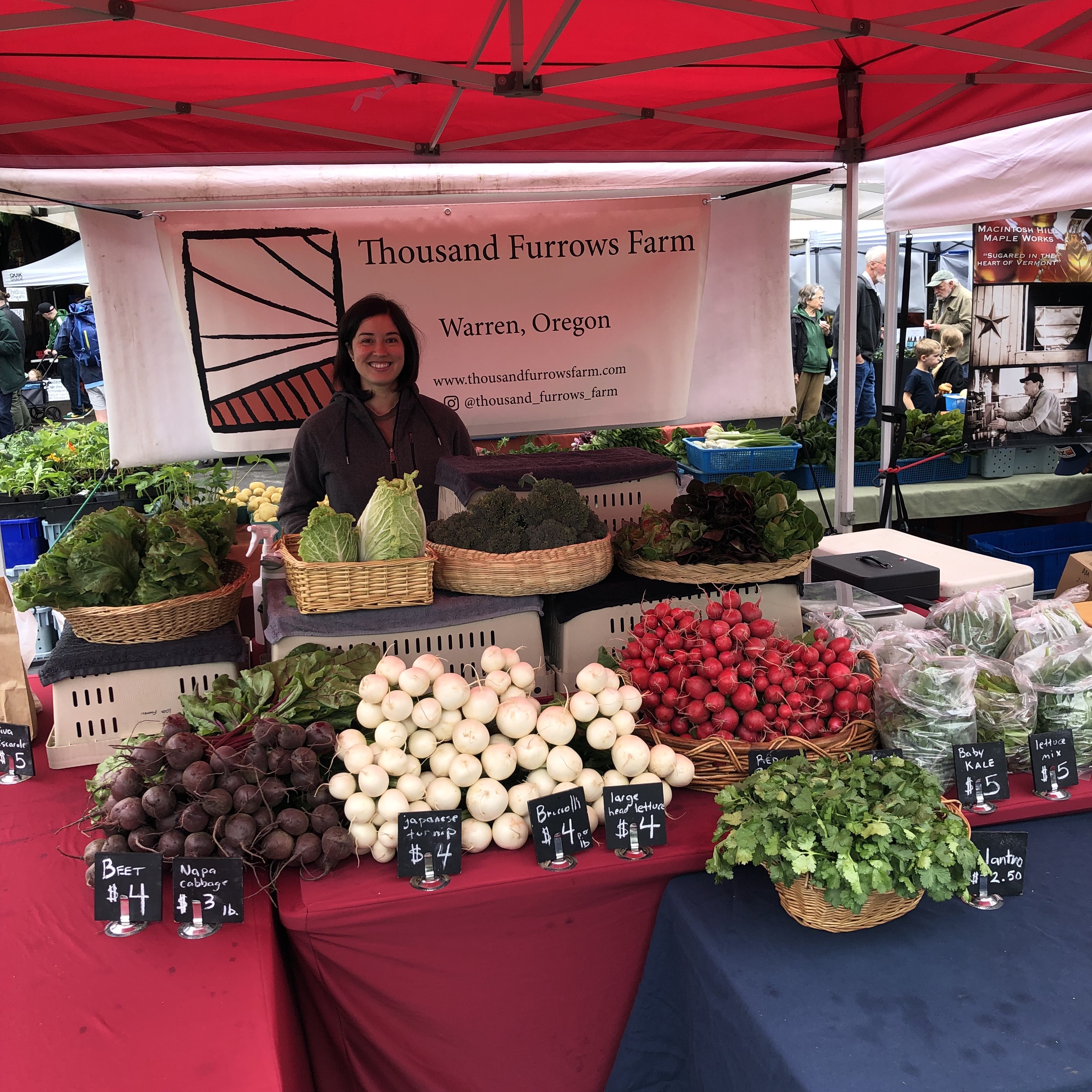
May 17th Market Stand.
4/15/25
Mid April and it feels fully spring. I am feeling quite on top of my planting which is enjoyable, and I still feel like I have the capacity to take a day off per week. I am deep in planting season now. Weekly sowings of greens kicked into full force at the end of March. To make way for the newest rounds of planting I have been laying out and doing initial preparation on a large segment of my beds on the south side of the property. Until recently, a row of tree stumps has inhabited the final 10’ of those beds. So far I have spent two days grinding those stumps, with another 2 days in my future. It is a lot of work, but it is also satisfying to make progress towards finishing one time, set-up tasks.
All of the beds I have prepped so far have never seen vegetables. They have been in cover crops for a year to 18 months. The beds were tarped for 2 months. Where the stumps were ground down I have removed several tons of wood chips. Where the stumps were excavated I filled in the cavities with soil. In the rest of the area, there is a decent amount of residue left over from the cover crops which I raked into the pathways. Then I broadforked the beds. This soil has never been prepared deeply, so it was tough going. Over time, broadforking will only occassionally be needed. Then I spread my amendments and used either a wheel hoe or my power harrow to break up the seed bed. So far I like how the wheel hoe prepares the soil, but it is a ton of work. The sod is dead, but the roots have not decomposed a lot and is still holding the soil tightly. This is generally a good thing, but is physically demanding. The power harrow is much easier and mixes in my amendments more evenly, but it is overkill. I am considering getting a cultivating setup for my walk behind tractor, which may do the trick with the right tooling. Finally, I would re-rake the bed and spread my compost on top. In beds that I didn’t compost immediately, I am seeing a flush of weeds. I am going to enourage these weeds and hoe them before I compost to kill off one or two flushes. Needless to say, it is a process.
3/2/25
We are just coming out of a short stretch of nice weather (sunny and 60s) that puts one in the mind for spring. December and January are the months that I take most off. Although now that I live on the farm I maintain a little more continuity with small amounts of harvesting and other work in the winter. This does ease the transition to working in the spring. One of the nice things about my farming season is that it really ramps up slowly.
In January this year I mostly harvested for the Clatskanie food hub and did my crop planning. Amazingly, the bulk of my crop planning was done in 8 hours. I pretty much know what I am going to plant at this point so crop planning amounts to making minor tweaks and deciding where everything is going to go. I spend additional time ordering my seed. My biggest growing goal for the season is to have plentiful carrots for as much of the season as possible. I am also going to grow more cherry tomatoes this year, as there are other farmers that do slicers better than myself. I am adding new varieties of cucumber and peppers as well. Last year my bell peppers were a little disappointing and everyone has them so I don’t sell a ton. I am going to focus on special varieties like stocky roasters, jimmy nardellos and some mini-bells that I am going to try.
February consisted of seeding, bed cleanup and prep and a bit of field planting. My harvesting for the food hub was pretty low in February as I have sold through almost everything that I had available! There is very little going to waste in the winter garden this year. I did overplant hakuri turnips, but just today I noticed that they are sending out raab. And I will sell as much of that as I can. I eat a TON of it too. Raab is one of my garden favorites for sure. Seeding, for transplants, feels well underway at this point. Broccoli, cabbage, spring chicories and my earliest seeding of tomatoes went in on Feb 9th. All of my onions, tomatoes and peppers are seeded too. Next week eggplant gets started. This year I added an all purpose organic fertilizer mix to my potting soil (in addition to my usual worm castings) and the improved nutrition seems evident. Looking forward to seeing how that affects my tomato and pepper starts.
In march, field planting will ramp up.
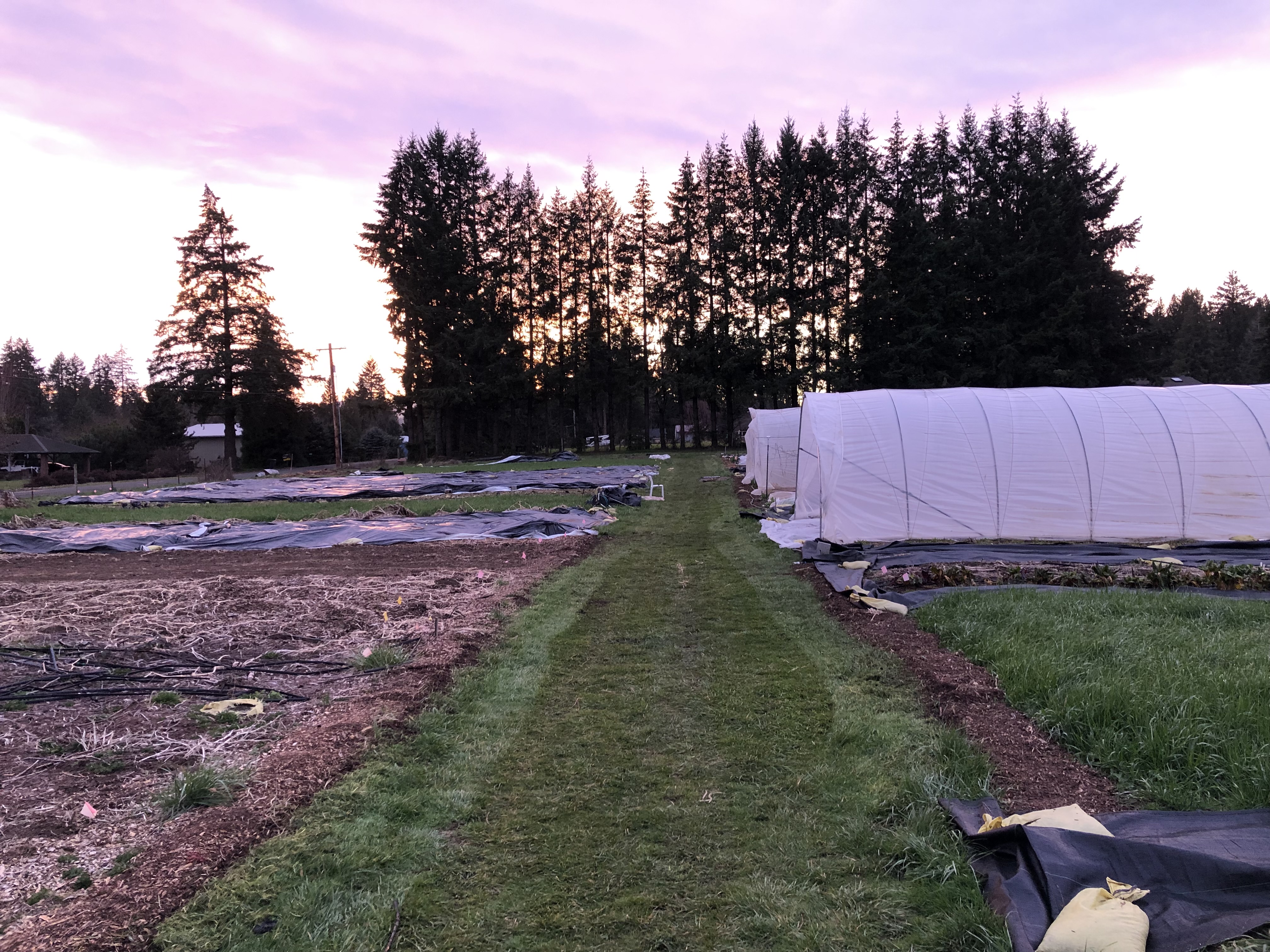
March 2nd Sunset on the Farm.
1/4/25
Well, I didn’t do a very good job with farm updates this year. I got a new computer at the start of the busy season and moving my website files over to the new machine proved enough of a barrier to prevent me from posting.
It ended up being a great season. So far I have managed to grow and sell more food, improve the profitability of the business and maintain a consistent level of effort each year. Which means that I get more food and $$$ in roughly the same amount of time. When all was said and done for the season I made roughly $17 per hour for my time (just shy of 1600 hours). And I managed to make a few long lasting investments in the farm as well including a used two door commercial refrigerator, a very nice - stainless steel - industrial salad spinner (for drying my washed greens), and a used - mini - electric flatbed truck for hauling stuff around the property. The truck in particular is going to save me a lot of labor. But don’t worry there will still be many wearisome tasks to keep me occupied.
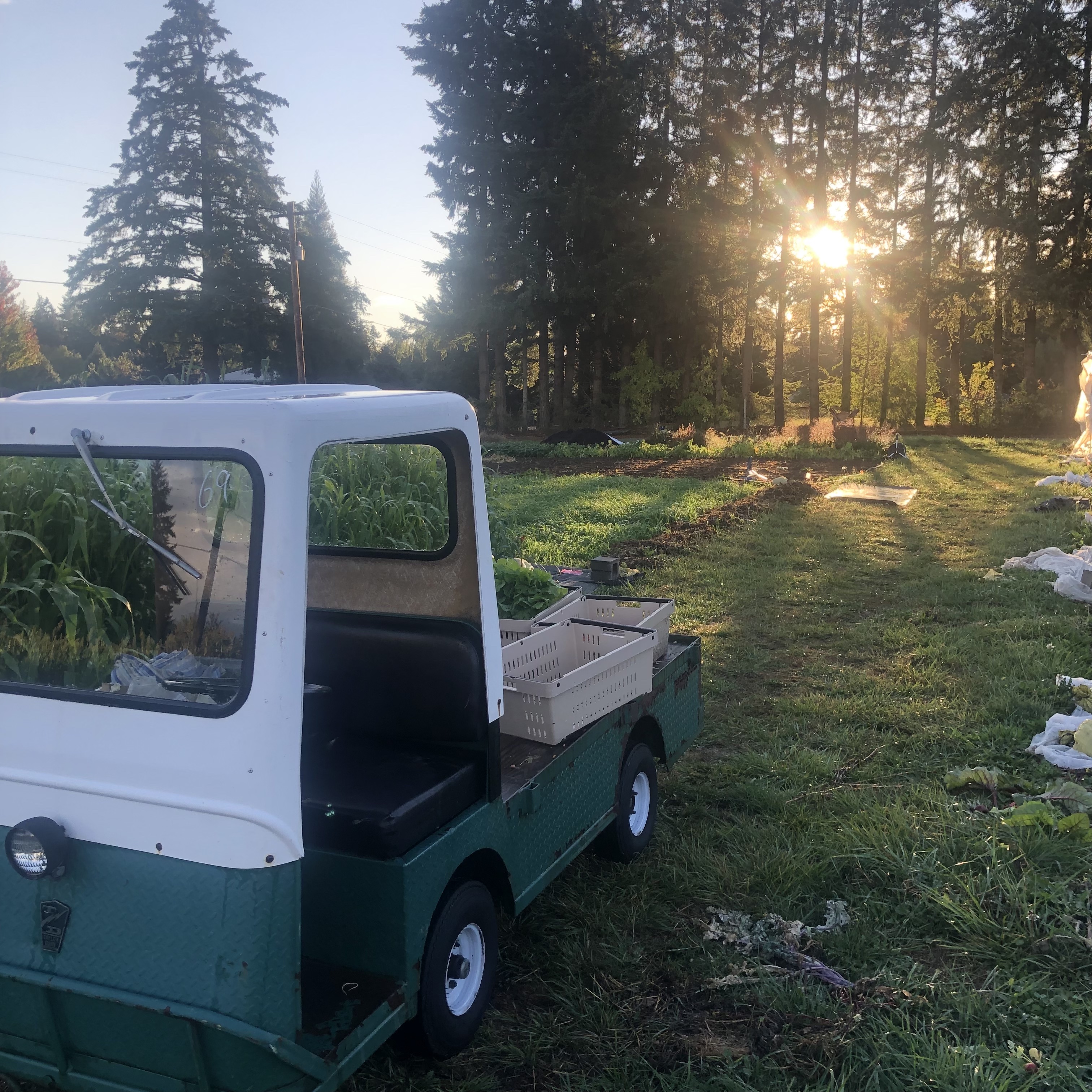
Taylor Dunn Electric Flatbed Truck. Can haul 3000 lbs!
Since starting the farm, my initial compensation goal has been to net $20 per hour. At the beginning of this last season, I still considered this goal something of a pipe dream. I have consistently lacked the vision to anticipate how I am going to grow the business without spending more time in the field or washing area, and yet consistently I have done so. In the moment is often hard to recognize your inefficiencies or imagine that you will be able to improve upon them by 25%, 50% or even 100% which is what it takes for a young business to attain profitability. They say that you are still a beginning farmer until you reach year 10. At the end of this season, I reach the conclusion of my fifth growing season. Which sounds like a major milestone to me. Yet even counting my years working on others farms, I still have at least 3 years to go as a beginning farmer. And with the wisdom I have attained at this stage, that sounds about right to me. It is exciting to think of the refinements that will come in the next five years.
4/5/24
Early April, about six weeks to market and there are plenty of plants in the ground. They always look really small at this stage and it is hard to imagine them sizing up for May 12th, but days are getting longer, plant growth accelerates, and somehow they do. The propragation house is full of plants and transplant season is about to start in earnest. Hopefully this weekend I put plastic up on the second greenhouse and then my first tomatoes of the season go in the ground. I do 3-4 monthly successions of Siletz - a very tasty, reliable, determinate red slicer - in a year. And I don’t treliss or prune them at all.
The workload is feeling manageable. It is nice to realize that in the absence of special projects, of which there are many, late March is a manageable time. Anything I can do to sneak in days or half days off before the farmers market season is a win. My main goal for coming seasons is to increase my profitability per hour. I would love my farm time to pay me $20 an hour. I think it is a reasonable goal.
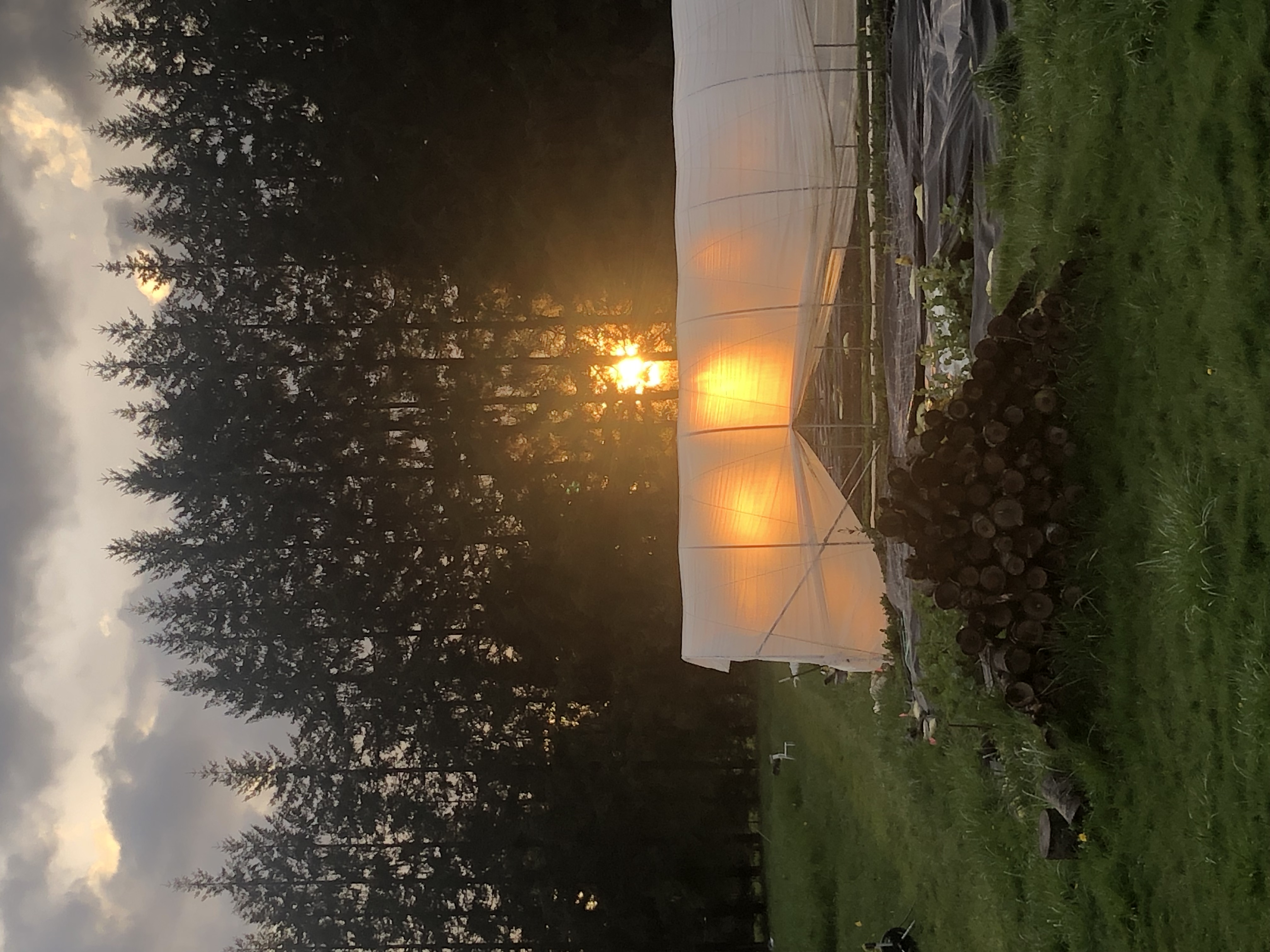
One of the best things about working outside is catching those transitional moments when magical things happen. It is one of the things I love about backpacking too. The moment when the rain stops and a beam of light hits a branch just right or a clear dawn after snowfall. They are easy to miss.
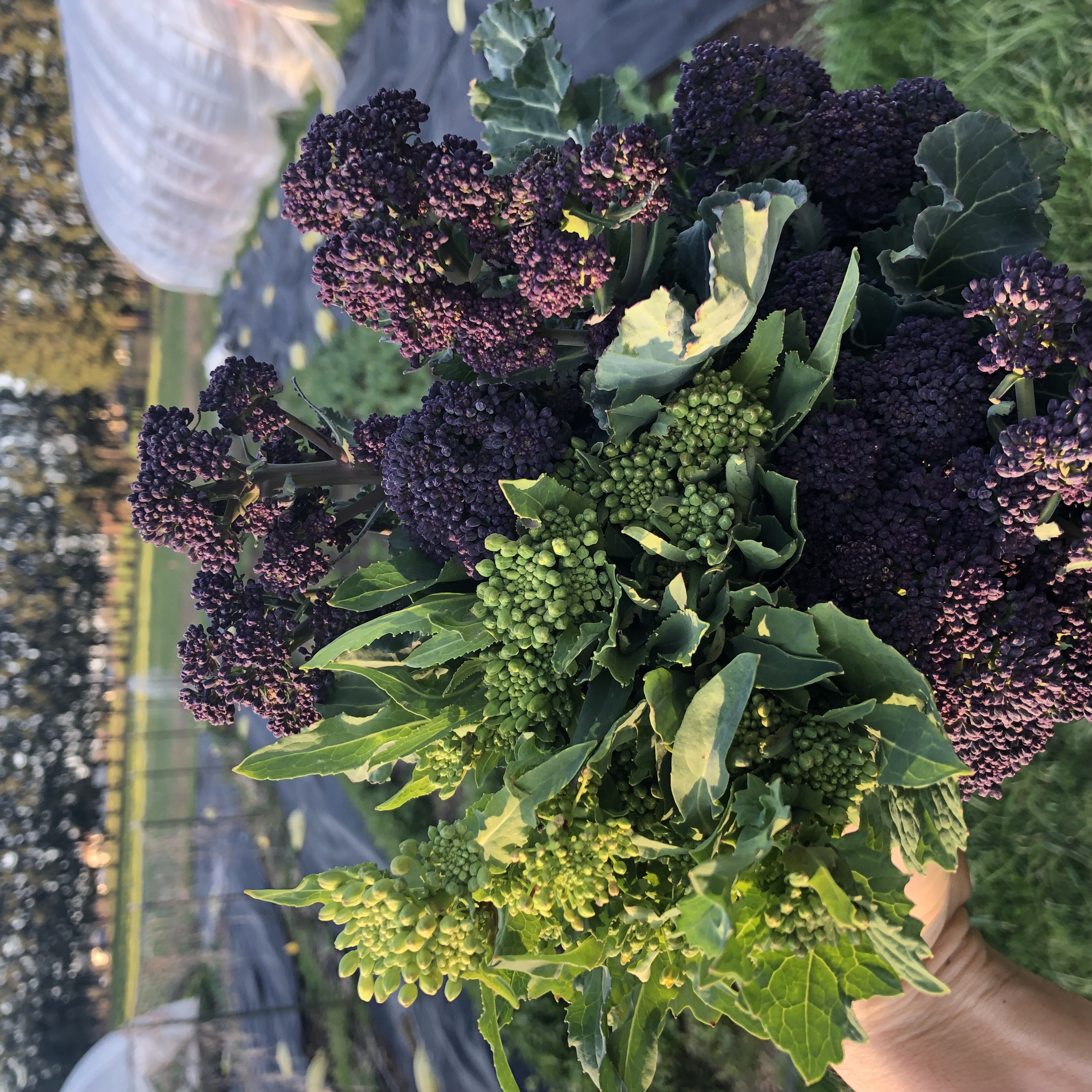
Peak raab season. A mix of mustard raab and purple sprouting broccoli.
2/18/24
Today it feels like the 2024 season has really kicked off. I planted my first in ground bed 2 weeks ago and today I seeded 5 trays including early tomatoes, broccoli, cabbage, head lettuce and chicory. My earliest trays I start in the basement under lights on heat mats. From here on out I will be watering trays and caring for baby plants until September or so and planting something almost every week. The rhythm of the season begins to kick in now. This is despite the fact that for the first time in the farms history I harvested veggies in January. While it feels good to take full advantage of the food that I have available, it is also nice to disconnect from the farm for a bit. In reality harvesting and transport is only 5 or so hours a week, but it maintains a mental thread that needs 2 or 3 weeks to sever. Preferrably longer. This past winter I think I got a 2 week break around Christmas, one week in January and one in February. In total, I worked 53 hours in January.
One of my main goals for future seasons is to increase my hourly wage. Limiting hours in the winter is key to achieving this goal. This includes time spent on special projects, spring clean-up and really anything not related to planting, harvesting and market.
Looking out on the farm now, I feel good about what I am seeing. I still have baby kale, cabbage, beets, cilantro, chard and small quantities of a few other things that survived the cold snap a few weeks ago. Two of my 12 field blocks (each block is 10 beds) are in cover crop, two are mulched and ready for no-till planting, 46 of my beds are under tarps of one sort or another to kill weeds and dry out the soil in preparation for planting. The mature weeds are dying more slowly than I would like under the tarps, but even if some survive the tarping they will be a lot easier to remove.
A couple of other goals for the season are to better document the success and timing of my early season plantings with an eye towards decreasing the frequency of my planting as much as I can get away with, especially in the shoulder seasons. I also want to develop a better crop by crop understanding of what is profitable. And continue to develop new systems for keeping the farm more organized.